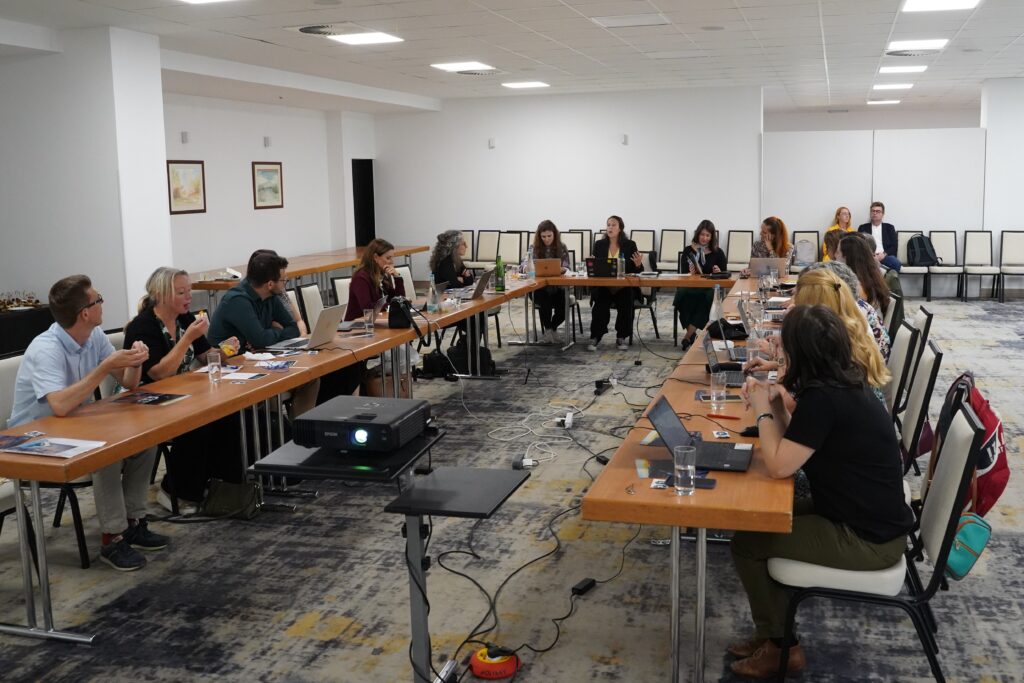

Researchers took an active role in shaping the future implementation of the SECURE Research Career Framework (RCF) during a dedicated workshop held in Szczecin on 18–19 May 2026, as part of the SECURE2 General Assembly.
The workshop, “Empowering Researchers to drive the SECURE Research Career Framework”, was co-organised by EURODOC – the European Council of Doctoral Candidates and Junior Researchers, ICoRSA – the International Consortium for Research Staff Associations, and the Marie Curie Alumni Association (MCAA). It brought together 25 researchers to explore how researchers can contribute to the uptake of the SECURE RCF at institutional level and help turn its principles into meaningful changes in research careers.
The workshop provided a space for participants to reflect on their own institutional environments, identify priorities for action and discuss the barriers that may hinder implementation. Through facilitated group discussions, participants also shared their perspectives on institutional priorities and communication gaps between researchers and their organisations. The collective insights will help inform future advocacy and communication activities within SECURE2.
Stability, working conditions and career pathways emerge as priorities
Among the eight action areas of the SECURE RCF, Stability and Working Conditions emerged as the most prominent priorities, each selected by half of the participants. Pathways was identified by one third of participants, while Strategy, Mobility and Interoperability received more limited support.
The discussions also explored the nine Tenure Track-Like Model (TTL) principles developed by SECURE. Transparency and Recognition through career pathways were the most frequently selected priorities, followed by Professional Development and Supportive Management.
These priorities underline researchers’ interest in career structures that provide greater clarity, stability and recognition, while supporting professional development and effective management.
Collective advocacy seen as key to driving change
Participants also discussed how researchers can contribute to promoting these priorities and influencing their implementation.
The strongest support was given to collective advocacy and engagement through representative structures. Engaging individually at European Union level and working through national organisations representing researchers were each selected by two thirds of participants. Raising awareness among individual researchers and advocating towards national authorities were also identified as important approaches.
When asked which stakeholders should play a role in driving change, organisations representing researchers at European level received unanimous support. National and local researcher organisations were also identified as important actors, alongside trade unions and, to a lesser extent, national authorities, institutional leadership and individual researchers.
Addressing the barriers to implementation
The workshop also highlighted several challenges that could limit researchers’ ability to contribute to institutional change.
The most frequently identified barriers were the limited representation of early-career researchers in decision-making bodies and the fact that time devoted to advocacy is not recognised or rewarded by institutions. Participants also pointed to a lack of information across the research community, limited awareness of how researchers can influence policy, and insufficient time to engage in advocacy activities.
Other barriers included funding constraints, restrictive national legislation and limited support from institutional leadership.
From researchers’ perspectives to future SECURE2 activities
The workshop brought together predominantly early- and mid-career researchers, with half of the participants identifying as R3 researchers and one third as R1 researchers. The perspectives gathered therefore provide valuable insight into the experiences and priorities of researchers at these career stages.
Rather than serving as a statistical survey, the workshop was designed as a collective data-gathering and reflection exercise, capturing a diversity of perspectives and identifying recurring themes that can support the implementation work of SECURE2 pilot institutions.
The findings will feed directly into the development of the SECURE2 Researchers’ Handbook on Advocacy around the Research Career Framework, while also informing the project’s wider communication and mainstreaming activities.
By bringing researchers into the conversation, the workshop in Szczecin reinforced a central principle of the SECURE2 approach: sustainable research career reform needs to be shaped with researchers, not only for researchers.
Photo: lacyec/Unsplash