“Many were skeptical of my results. They told me that what I was working on was not medicine, that it was useless. But I could see the progress. When students ask me how I managed to keep going, I reply: don’t give up!”
Author: Djordje Petrović
“A world that lacks an important contribution appears perfectly ordinary. That is the definition of the status quo. I don’t know where that thought came from on that particular day, but it carried me through all those years of invisibility – years in which nearly every message I received, implicit or explicit, suggested the same: Kathy, this job is not for you,” writes Dr. Katalin Karikó in her autobiography Breaking Through: My Life in Science.
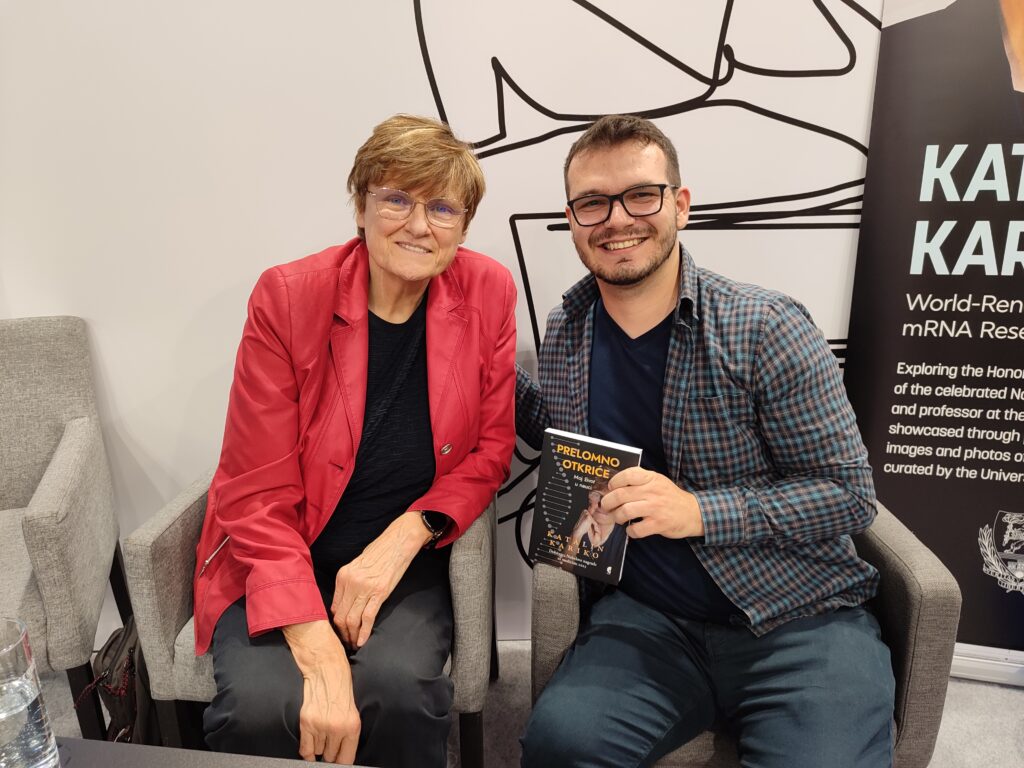
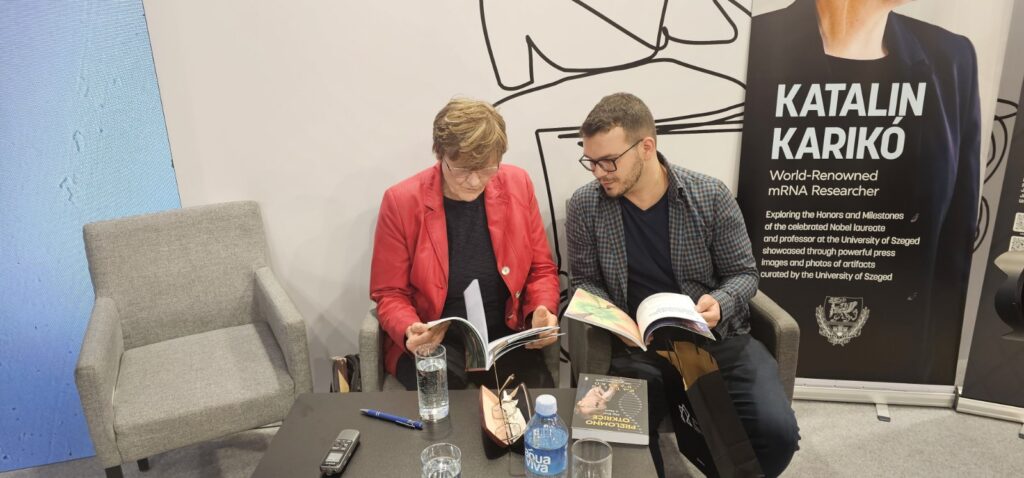
This inspiring book, written by the 2023 Nobel Prize laureate in Physiology or Medicine, has recently been published in Serbian by Službeni glasnik. At its launch during the International Belgrade Book Fair 2025, Dr. Karikó attended in person at the publisher’s invitation to speak about the book. In an engaging and candid conversation, the award-winning scientist shared parts of her life with the Belgrade audience – a life that was anything but easy.
Born in post-WWII Hungary, she grew up in modest, at times very difficult circumstances. An early fascination with nature led her toward science, and in the early 1980s, she earned her PhD in biochemistry at the University of Szeged. Driven by a strong desire to advance her research, in 1985 she emigrated to the United States with her husband and young daughter, bringing with her everything she had – a deep scientific ambition and $1,200 sewn into a teddy bear. Yet new challenges awaited her there: windowless laboratories, chronic lack of funding, skepticism and ridicule from colleagues, threats of dismissal, and even deportation. Still, she never lost faith in her work and continued to explore the therapeutic potential of messenger RNA (mRNA) – the molecule that carries instructions from DNA and enables cells to produce proteins.
It was precisely this persistent, almost defiant pursuit – long dismissed by many as unpromising – that led Dr. Karikó to the discovery that would earn her Nobel laureate status and usher in a new era of medicine. Together with American immunologist Drew Weissman, with whom she shared this prestigious award, she demonstrated that modifying a single building block of RNA prevents the unwanted and excessive immune response that had previously hindered the therapeutic use of mRNA. This breakthrough paved the way for the development of safe and effective mRNA vaccines – a technology that helped curb COVID-19 and now holds promise for revolutionizing the treatment of a wide range of diseases, from infectious and rare diseases to various forms of cancer.
The publication of her autobiography in Serbian and her first visit to Belgrade provided an excellent occasion to speak with Dr. Karikó, beneath the ribbed vault of Hall 1 at the Belgrade Fair, about her winding and arduous journey to the peak of the scientific Olympus.
Your groundbreaking discovery, which was awarded the Nobel Prize, has contributed not only to the advancement of science but also to saving millions of lives. How do you view this remarkable scientific achievement?
I don’t see it as something I accomplished on my own. I was just a part of a much larger scientific endeavor. Many people were involved, so this success belongs to all of us together. In fact, my work builds on decades of research by numerous scientists, some of whom are no longer even alive.
As scientists, it is our task to learn from what others have done and to take it a step further, in line with our own capabilities. I have always hoped that someone would one day continue my work and develop it further, just as I built on the achievements of others. That is why I see all of this as the result of the efforts of thousands of scientists. Science is a collective endeavor – it is a team sport!
Of course, I can understand a young researcher who might be carried away by the feeling of having achieved something alone. But I am 70 years old, and I know how many people contributed to our research before me – and that is how science works as a whole. That is why I divided all the prize money I received with the Nobel Prize into many smaller shares and awarded it to outstanding students and teachers.
Among the recipients, for example, are a 91-year-old literature professor who worked at our institution, a medical student, and a physics teacher. It is important to give back to the community. That is why the original medal I received from the Nobel Committee is now in a museum, while I carry a replica with me.
That is truly very generous of you. However, beyond the financial aspect, the Nobel Prize carries immense prestige and is a dream for many scientists. Should a researcher strive for the Nobel Prize as a goal?
I always tell young colleagues to focus on goals that are within their control. Awards are not – those decisions are made by committees, by institutions like the Karolinska Institute, or by other organizations that vote. That is simply not something you can control.
Your goal should be to better understand science, not to advance your career. Progress in science is the product of curiosity and dedicated work. In the 19th century, scientists wanted to understand nature. Today, they just want to publish in Nature.
Looking back today, given that your discovery opened the door to an entirely new era of medicine –was there a defining moment that truly changed the course of your research? Do such “turning points” even exist in science?
As early as the beginning of the 1990s, scientists were already using messenger RNA (mRNA) in experimental vaccines administered to animals. By the mid-1990s, the first papers on its use in cancer treatment had also begun to appear. Many researchers set out along that path, but unfortunately, they did not receive sufficient funding and were unable to continue their work in that direction. In the following decade, however, companies such as CureVac and BioNTech began to emerge, aiming to develop RNA-based cancer vaccines. Today, many research teams around the world are working on this. So, it is a process that has matured over time, rather than something that happened in a single moment.
In science, there is rarely a moment when you can say, “This is it!” Typically, you carry out an experiment, get a result that surprises you, and then repeat it – only to get something different. Then you begin to wonder whether you made a mistake somewhere. In other words, as scientists, we always strive to remain skeptical of our own findings. That is why I cannot point to a single key moment that led to the discovery. After all, we did not really “discover” messenger RNA – it already exists in nature, in our bodies.
Due to difficult financial circumstances and the inability to pursue your scientific ambition, you left Hungary with your family. Yet in the United States, challenges, skepticism, and obstacles followed you throughout much of your career. How did you manage to maintain faith in yourself and your work during those difficult times?
You have to believe in your research. I believed because I could see constant progress in it. I started with different formulations, tried new lipids, modified the mRNA, optimized it, and eventually managed to get 10,000 times more protein from it. Yet many were skeptical of my results. They told me that what I was working on was not medicine, that it was useless. But I could see the progress. When students ask me how I managed to keep going, I reply: Don’t give up!
Of course, there were moments when nothing worked – for example, I spent two years trying to crystallize a protein and simply couldn’t. In such moments, you have to decide. I could see some progress in my work, so I kept going. Perhaps it was pure persistence, but it was precisely that belief in the visible results of my work that helped me not give up.
Your partnership with Drew Weissman, with whom you shared the Nobel Prize in Physiology or Medicine two years ago, has become one of the great stories of contemporary science. How did your collaboration actually develop, and why did you work so well together?
First of all, we were in a similar situation. Even though he is American, it was difficult for him to secure funding. So, he, like me, had to roll up his sleeves and carry out his own experiments. I was running gels, culturing bacteria, isolating plasmids (small, circular DNA fragments used to transfer genetic material into cells). It is an old-fashioned lab routine. I would start early in the morning, plan which task would take the most time that day, culture cells, and do whatever was needed. He did all of that as well.
Among other things, he was experimenting with dendritic cells – a type of human cell that presents antigens and triggers an immune response. When I met him in 1997, I didn’t even know these cells existed, but they later helped us understand that mRNA can induce inflammation, that is, an inflammatory response. If you use non-human cells, you wouldn’t notice that. By then, I had already been working with mRNA for ten years and had even injected it into animals, but I had not observed any adverse effects. Even later, when experiments were conducted on monkeys, their immune response to mRNA was similar to that of mice, but not to that of humans.
For a good collaboration, you have to trust each other and build a relationship of mutual confidence. Drew had a different kind of expertise – immunology – while I was an RNA expert. We taught each other and, together, came up with new ideas. For example, when we discovered that modifying mRNA reduces its ability to trigger an immune response, he, as a physician, said: “We should take samples from patients with lupus – maybe people develop autoimmune diseases because their mRNA is not modified.” In other words, he brought ideas from medical practice, and I brought them from biochemistry. That is how we complemented each other and developed new solutions together.
Over the course of your career, you have worked both in academia and in industry. How do you see the differences between these two worlds – especially in terms of motivation and the way scientific work is evaluated?
In academia, I very quickly noticed a problem: when publishing papers, there is often a struggle over who will be the first or the last author – those are the two most important positions – while the others receive less recognition, that is, less credit. When I moved to the industry, it was a refreshing experience. There, that was not important. Everyone has to work together because we need to create a product. If we don’t, we can close the lab and go home. That was a far better goal than simply accumulating credentials and publishing papers, which today is often the primary measure of success in science.
As I mentioned earlier, the goal of a scientist today is often not to understand nature, but to collect as many points as possible for the next promotion. For example, I interviewed a student from Harvard and asked him about iron–sulfur clusters – metal–sulfur complexes that are crucial in many biological processes – and he told me he had never heard of them. I look at his paper and see that at the end he included a reference to a paper about them. I say to him: “That was the title of a paper you co-authored – weren’t you at least curious about what that molecule is?” I told him I did not want to work with him. In other words, he cited that reference to prove something to someone else, without any real interest in what he was referring to. I see this as a major problem among young scientists, especially today, in the era of widespread social media. It seems they are more concerned with impressing others than with finding their own authentic path.
It is not only like that in the scientific community, but in other spheres as well. My husband worked in a factory in three shifts. When someone with a PhD marries a factory worker, as I did, many people immediately think that something must be wrong – no one says that it is wonderful. But many of those people are already divorced, while we have been together for 45 years. Not only because he is kind and funny, but because we care about each other, not about how we appear to others. People often live to meet other people’s expectations, to fit into their ideas – to look good in a photo, under a palm tree, to make an impression – instead of thinking about what truly makes them happy.
Researchers today face considerable pressure: they are expected to produce “measurable results,” publish them quickly, and secure funding. As a result, many choose safer projects and are less inclined to pursue riskier but potentially groundbreaking research. You yourself nearly lost your position twelve years ago because your work, in the view of your superiors, was not bringing in sufficient funding for the institution. In your opinion, what needs to change in the academic system for truly innovative research to receive greater support?
I think we need to stop measuring scientists solely by the number of papers and the number of citations – that is, by pure numbers. We should also stop placing so much value on where a paper is published – whether in prestigious journals such as Nature and Science or elsewhere. I received the Nobel Prize without having published a single paper in either of those journals.
We now also face the problem of scientific overproduction – the mass production of flawed or even fabricated papers, with insufficiently verified or invented data. It often happens that already on the second page of a manuscript I can see how bad it is – I notice typographical errors, outdated data, obviously superficial writing, and I immediately know there is no point in continuing to read. However, for young researchers it is truly difficult to recognize what is worth reading in that forest of papers.
In the past, scientific papers were published to share a new discovery with colleagues. Today, they are published to obtain funding and build larger research teams, which then become machines for producing papers. Sometimes, unfortunately, paper is published before it is truly ready. At the same time, the project leader is seeking advancement – a title, a permanent position, a professorship – and research becomes merely a means for career advancement, rather than an end in itself.
I do not know how to fully fix that system, but I am certain that we should not rely on mere numbers. In Hungary, I have seen names with three hundred, four hundred papers – and no one knows who they are. I don’t even have a hundred papers, and I never will. But I tried to do each of them carefully and to make sure the results are reproducible. If you ask me anything about them, even the smallest detail, I know the answer – because I handled every step of the process myself.
Your autobiography is truly a masterpiece of science communication. It does not present only your scientific achievements and the challenges you faced, but also the everyday life of a researcher. Why is it important, in your view, for scientists to communicate their work to the public?
Science, in short, is knowledge gained through observation, forming hypotheses, and experimenting to test whether those hypotheses are correct. That is how we advance knowledge, and that is how science works. But scientists usually do not explain clearly enough to the broader public what they actually do and why they do it. If, for example, we study the behavior of the fruit fly, people will say, “Who cares?” And we have to explain that we are not doing this to make the fruit fly happier, but because it is a model organism in biology. Thanks to such research, for instance, receptors have been discovered that were later found to exist in humans as well and are crucial for understanding the human immune system, which has enabled the development of new therapies.
Otherwise, people get the impression that we are elitists, that we do not care about them, and that we develop treatments they ultimately cannot afford. They know that the grants funding our research come from their taxes, and if we do not explain what we do – for example, how vaccines work (which are mostly free) – a gap emerges that someone else will fill. And that someone else may sell them “detox” products and profit from their fear. In other words, we leave room for pseudoscience to flourish.
An additional problem is that social media algorithms favor content that provokes fear, because such content attracts more attention. If you write a headline like “Broccoli is healthy,” almost no one will click on it. But if you write that broccoli is dangerous to your health, many people will want to read the article and will stay on the page longer – which means more ads and more revenue. Profit matters, even if the content is completely untrue.
Journalists often tell me that people are not interested in science. And even when they are, in popular culture they encounter negative figures such as Dr. Frankenstein – malicious and irresponsible geniuses who do frightening things. In reality, scientists are mostly ordinary people who work extremely hard and are not in science to become rich. I remember one summer when I realized that not a single day had passed – including holidays and weekends – without me stopping by the lab to get some work done, even if only for an hour. And while we are busy with our work in the lab, such images of science still dominate outside it.
That is why I believe we need to devote more time to communicating science and to showing the real life of researchers. And I hope this conversation is at least a small step in that direction.
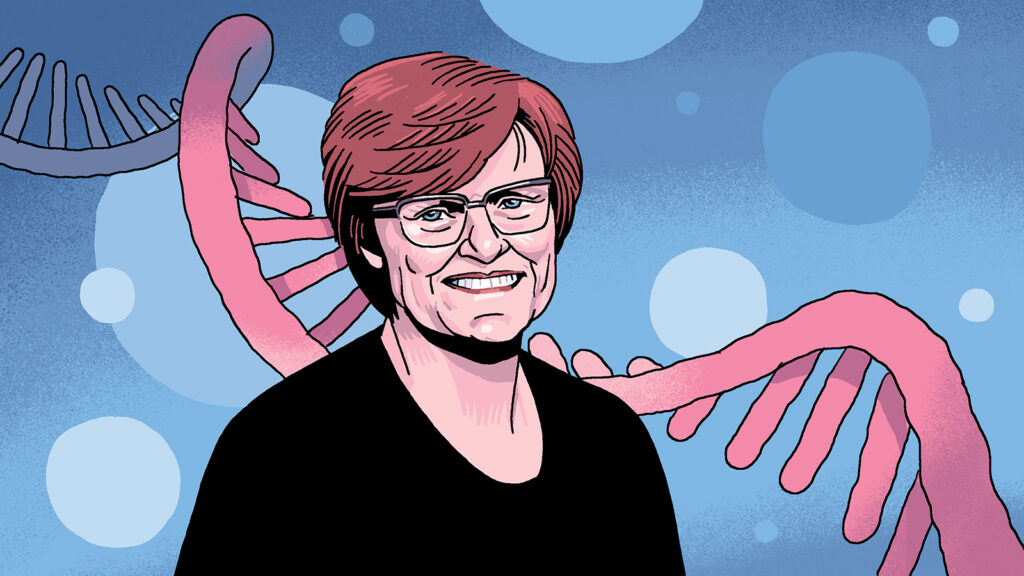
Illustration: Nikola Korać
This interview was originally published in Issue 43 of Elements magazine.